
Foundation Sliding
Introduction
Foundation sliding is one of the fundamental stability checks performed when designing shallow foundations. When horizontal forces act on a structure, those forces are transferred to the foundation and ultimately resisted by the interface between the footing and the supporting soil. If the available resistance along that interface is insufficient, the entire foundation can translate laterally, potentially leading to structural distress or failure.
Sliding checks are commonly required for spread footings, mat foundations, retaining wall foundations, and equipment foundations where lateral loads from wind, seismic forces, earth pressure, or structural framing reactions are present.
While structural strength checks for reinforced concrete members are typically governed by ACI 318, overall foundation stability checks such as sliding are addressed in the International Building Code (IBC). Specifically, IBC Section 1806.2 provides guidance for evaluating resistance to lateral sliding at the soil foundation interface.
In this post, we walk through the key aspects of foundation sliding checks, including how sliding resistance is determined, how lateral demand is evaluated, and important considerations engineers should account for when verifying foundation stability.

Factors to Consider in Foundation Sliding Design
Foundation sliding checks depend on both loading conditions and soil interface behavior. Changes in vertical load, soil properties, or foundation geometry can significantly influence the available sliding resistance.
Structural Configuration:
Purpose: Understand how vertical loads, horizontal forces, and the soil interface interact to develop sliding resistance.
Considerations:
Horizontal loads acting on the structure may originate from wind, seismic forces, earth pressure, equipment loads, or frame reactions.
These forces transfer through columns or walls into the foundation and must be resisted at the base of the footing.
The available resistance depends primarily on friction between the footing and the supporting soil.
Additional resistance may be provided through passive soil pressure or shear keys depending on the foundation configuration.
The magnitude of vertical load acting on the footing strongly influences the available sliding resistance.
Sliding Resistance Per IBC 1806.2:
Purpose: Determine the available resistance that prevents the foundation from sliding along the soil interface.
Considerations:
The available resistance is typically calculated as the coefficient of friction multiplied by the total vertical load acting on the foundation.
Vertical load may include the weight of the structure, the footing self weight, and any overburden soil.
The coefficient of friction depends on the soil type and the condition of the footing soil interface.
IBC also permits the use of passive soil resistance in some cases, though it is often limited or conservatively reduced.
When shear keys are used, additional resistance may be developed through mobilization of passive earth pressure.
Sliding Demand:
Purpose: Quantify the total horizontal force acting on the foundation.
Considerations:
Sliding demand is determined from the sum of all lateral loads acting on the structure and transmitted to the foundation.
These loads may include wind forces, seismic base shear, earth pressure, or lateral reactions from structural framing.
For foundations supporting columns or frames, sliding demand is typically obtained from the structural analysis model.
Both service level and strength level load combinations may need to be considered depending on project requirements.
Load combinations should remain consistent with the assumptions used for soil bearing pressure and overturning checks.
Punching Shear Capacity Factor of Safety Against Sliding:
Purpose: Verify that available resistance exceeds the applied sliding demand.
Considerations:
The factor of safety against sliding is typically calculated as the ratio of available resistance to applied horizontal load.
A factor of safety greater than the required minimum indicates that the foundation is stable against lateral translation.
Required safety factors may vary depending on local building code requirements and project specific criteria.
When passive resistance or shear keys are included, conservative assumptions should be used to account for uncertainties in soil behavior.
Consistency between sliding checks, overturning checks, and bearing pressure calculations is important for reliable foundation design.
Important Details to Be Aware of in Foundation Sliding Design
Sliding checks are conceptually simple but require careful attention to assumptions about soil behavior and loading conditions. Small changes in vertical load or friction coefficients can significantly affect the calculated resistance. Passive soil pressure is often difficult to mobilize fully and should be used conservatively. Construction conditions, such as the presence of formwork, smooth concrete surfaces, or moisture at the soil interface, can also influence the effective coefficient of friction. For foundations subject to significant lateral loading, sliding should be evaluated alongside overturning and bearing pressure checks to ensure overall stability of the system. Maintaining consistency between structural analysis results and geotechnical assumptions is essential to producing reliable and defensible foundation designs.
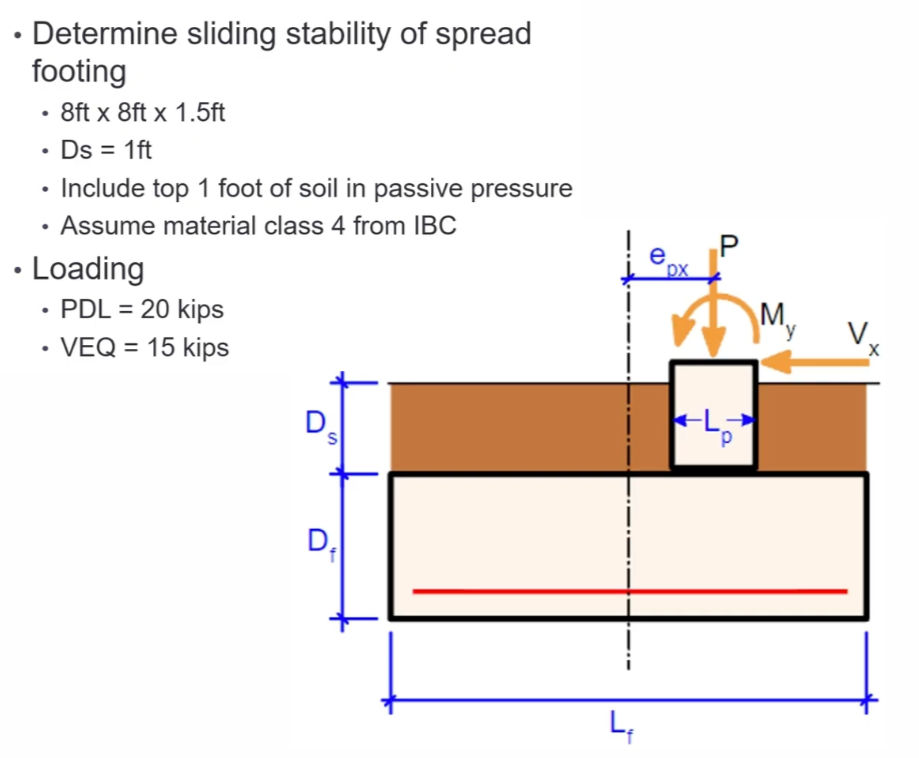
Example Problem (Solutions Provided Using CalcBook): Overview:

Problem Statement:
Demand Calculations:

Passive Pressure:

Sliding Resistance:

Results Summary:

Conclusion:
In conclusion, evaluating foundation sliding is a fundamental part of shallow foundation design whenever horizontal loads are present. By clearly identifying the sources of lateral demand and verifying that adequate resistance is developed at the soil foundation interface, engineers can ensure that foundations remain stable under service level loading. Using the guidance provided in IBC Section 1806.2, sliding resistance is typically evaluated through friction between the footing and supporting soil, with consideration given to vertical load magnitude, soil properties, and foundation configuration. While structural strength checks for reinforced concrete elements are generally governed by ACI 318, overall foundation stability checks such as sliding must also be verified to ensure the system performs safely as a whole. Careful coordination between structural analysis, geotechnical assumptions, and conservative evaluation of resistance mechanisms helps produce reliable and well documented foundation designs.


